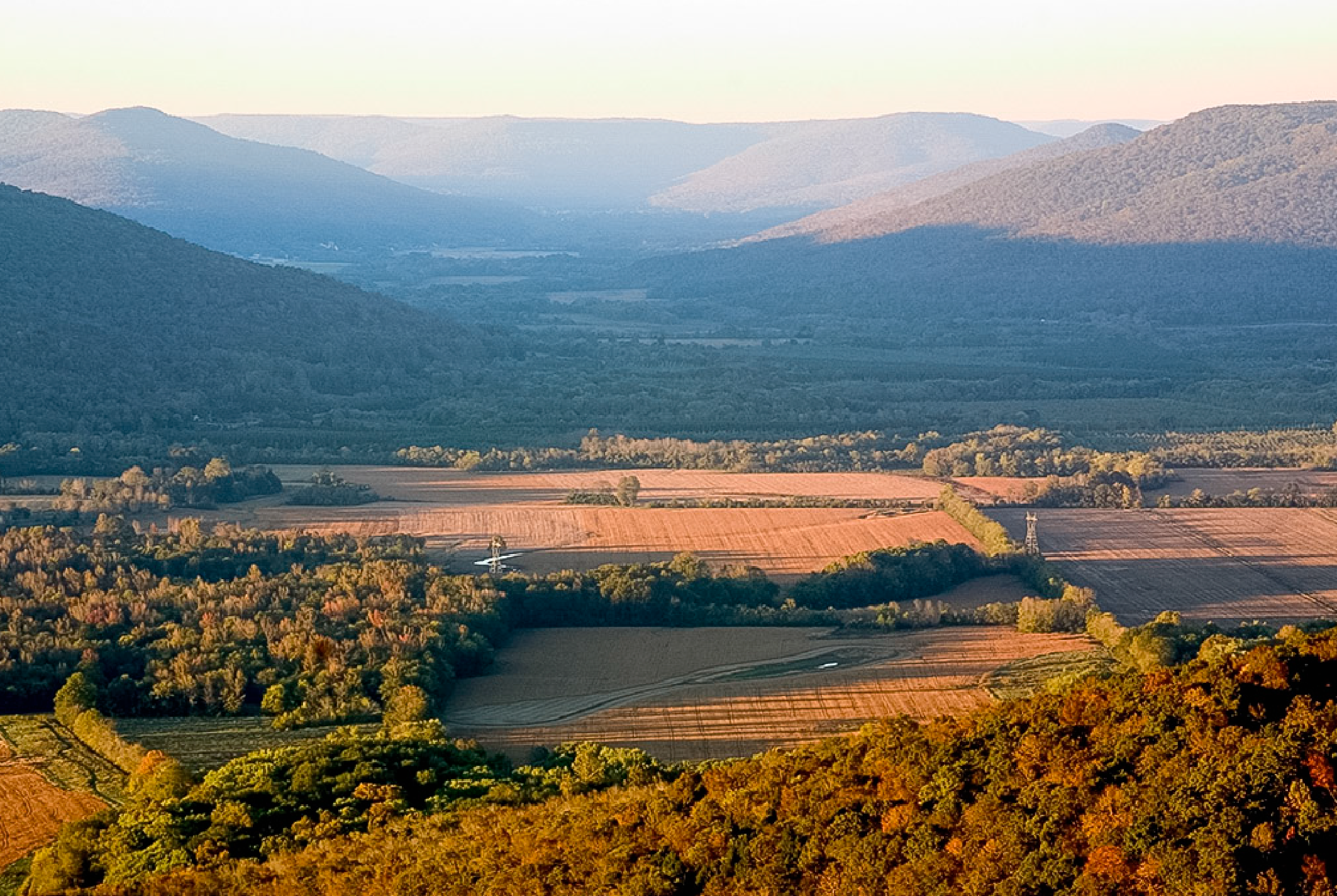
Paint Rock Valley
Photo by Beth Finch

Harvard Forest offers many traditional outreach programs involving artists, scientists, and K–12 schools. However, where it really excels is in its community partnerships, which move beyond one-way outreach toward the co-production of knowledge. These two-way interactions allow scientists and community members to learn from one another and contribute to the research process, an approach that has been shown to help build trust in science.
-
Harvard Forest provides extensive research resources designed for use by scientists, educators, students, land managers, conservation organizations, and the public. As a Long-Term Ecological Research (LTER) site, Harvard Forest maintains long-term ecological datasets examining forest dynamics, climate change, invasive species, land-use change, and other environmental processes. Its online resources include research datasets and metadata, publications, project abstracts, archives, sample collections, and real-time environmental data such as stream discharge, wetland water levels, and solar radiation. Long Term Ecological Research Program
A particularly strong example of translating research into a community-useful tool is the New England Landscape Futures (NELF) Explorer. The project brought together more than 100 New England stakeholders to develop alternative scenarios for how the region's landscape might change. The resulting maps and visualization tools allow conservationists, planners, educators, and community members to explore how different land-use choices could affect ecosystem services and landscapes. Scenario maps are available for viewing and free download, extending the research beyond the academic community. S3 RCN Project
Harvard Forest also makes research resources accessible to younger audiences through its Schoolyard Ecology program. Participating K–12 students collect authentic ecological data in their own schoolyards, and the Schoolyard database allows students and educators to submit, download, graph, and analyze these data. Teacher resources include lesson plans, presentations, data-analysis materials, and access to Harvard Forest scientists. Schoolyard Ecology Harvard Forest
Community-engagement strength: This is more than simply making scientific information publicly available. In projects such as NELF and Schoolyard Ecology, users participate in either the production, interpretation, or application of knowledge, making the resources useful examples of community-engaged scholarship.
Harvard Forest Research Resources
NELF Explorer
Schoolyard Ecology -
Harvard Forest's communication activities emphasize connecting ecological research with people's relationships to forests, landscapes, and local communities. Its strategic plan describes engagement as a two-way process in which Harvard Forest seeks not only to share its research but also to hear and empower stakeholders and create opportunities for diverse audiences to benefit from its land and research. The goal is to translate scientific knowledge into information that can guide policy, improve livelihoods, inform stewardship, and address environmental problems. Harvard Forest
The NELF project provides an especially strong example. Rather than scientists independently determining possible futures for New England forests, researchers convened stakeholders in six state-level workshops to identify drivers of landscape change and develop possible future scenarios. Common elements from those conversations were then combined into regional scenarios. The resulting science therefore incorporated the perspectives of people involved in land use, conservation, management, and planning. Harvard Forest
Harvard Forest is also working to reconnect its research and interpretation of place with Nipmuc perspectives and knowledge. Because the Forest occupies ancestral Nipmuc land, Harvard Forest has developed relationships with local Indigenous communities intended to influence research, conservation, and educational programming. One project brought Harvard students together with Nipmuc community leaders to reconsider trail signage so that interpretation of the landscape would better incorporate Native American knowledge and perspectives. Harvard Forest
Community-engagement strength: Harvard Forest's strongest communication efforts move away from the traditional scientist → public model. Projects such as NELF and its Nipmuc partnerships create opportunities for community knowledge and values to influence how environmental issues and landscapes are interpreted.
Harvard Forest Engagement and Outreach Strategy
Indigenous Community Partnerships -
Education and public programming are major components of Harvard Forest's engagement strategy. Programs serve audiences ranging from elementary school students and teachers to undergraduate and graduate researchers, land professionals, conservation practitioners, and the general public. Harvard Forest currently reports reaching approximately 2,500 people annually through tours, events, and workshops. Harvard Forest
The Schoolyard Ecology program, operating since 2004, is one of the strongest examples. Students conduct long-term ecological investigations in their own schoolyards while teachers receive professional development and direct support from Harvard Forest scientists. The Summer Institute trains teachers in implementing ecological field research, while additional workshops develop skills in collecting, managing, analyzing, and interpreting ecological data. Harvard Forest
Programming extends beyond formal science education. Harvard Forest's LTER program specifically identifies arts and humanities, conservation, and policy as mechanisms for broadening the public impact of its research. The Forest also hosts field trips, tours, seminars, conferences, public events, and community programming. Locally, Harvard Forest contributes programming to Petersham's annual Arbor Day celebration and provides the nearby Petersham Center School with an annual series of nature programs and a free after-school Science and Nature Club. Harvard Forest
The NELF project adds another layer of engagement through stakeholder workshops, webinars, scenario-development meetings, and training around the NELF Explorer. These programs brought scientists together with practitioners to consider how scientific information could be used in actual conservation, planning, policy, and land-management decisions. Harvard Forest
Community-engagement strength: Harvard Forest offers programming at several levels of engagement, from traditional tours and public education to sustained programs where teachers, students, land professionals, and other stakeholders participate in research and knowledge exchange.
Harvard Forest Education & Opportunities
Schoolyard Ecology Workshops -
Partnerships appear to be one of Harvard Forest's greatest strengths as a community-engaged research organization. Although Harvard Forest is a department of Harvard University's Faculty of Arts and Sciences, it operates within extensive regional and national networks of universities, government agencies, conservation organizations, nonprofits, schools, land managers, and community organizations. It is also part of the U.S. LTER Network and maintains partnerships with organizations including the USDA Forest Service, USGS, Highstead, Mount Grace Land Conservation Trust, and numerous universities. Harvard Forest
The S3 Research Coordination Network/New England Landscape Futures project is particularly valuable for evaluating community voice. Its network deliberately connected researchers with practitioners and land-use stakeholders. Stakeholders helped identify major drivers of landscape change, develop scenarios, define ecosystem services of interest, and consider how the resulting research could inform conservation and planning. The project described one of its objectives as building a collaborative regional network of researchers and practitioners and applying the resulting knowledge to policy, planning, conservation, and land management. Harvard Forest
This participatory approach also affected the research itself. The S3 RCN identified co-development of qualitative land-use scenarios by scientists and stakeholders, evaluation of ecosystem services defined with stakeholders, and knowledge-sharing with broader audiences as central objectives. Activities included science-and-stakeholder workshops, technical workshops, synthesis meetings, and webinars. Harvard Forest
Harvard Forest's more recent strategic plan pushes this idea further by explicitly identifying the need to hear and empower stakeholders, rather than treating surrounding communities simply as audiences for scientific information. Its relationships with Nipmuc communities similarly demonstrate an effort to include community perspectives in research, conservation, education, and interpretation. Harvard Forest
Community-engagement strength: Harvard Forest has strong institutional partnerships and several excellent examples of shared decision-making and co-production. However, the degree of community voice varies substantially by program. Some activities remain conventional outreach or education, while initiatives such as NELF and the Nipmuc partnerships demonstrate deeper forms of engagement in which outside stakeholders influence research questions, interpretation, or application.
Harvard Forest Community Partnerships
S3 Research Coordination Network
Research Stations With Good Models

While many university engagement programs focus on bringing academic knowledge into communities, McMaster University’s Research Shop reverses this relationship by allowing community organizations to identify the questions that university researchers help answer. This structure gives community partners a meaningful voice in determining what knowledge is produced and how it will be used. I think a model like this could be extremely beneficial to Paint Rock Research Center and represents a gold standard for community-engaged scholarship.
-
The McMaster Research Shop connects public, nonprofit, and community organizations in Hamilton, Ontario, with university students who provide research support at no cost. Rather than beginning with questions generated by university researchers, the process begins when a community organization identifies a question or problem for which it needs evidence. Research Shop staff then work with the organization to refine the question and determine an appropriate research approach.
Research teams may conduct literature reviews, environmental or best-practice scans, surveys, interviews, or focus groups. The resulting resources can include recommendations, reports, infographics, pamphlets, and other products specifically designed for the community partner. The goal is practical: helping organizations improve programs, make decisions, seek funding, advocate for policy changes, or raise awareness. Community Engagement
Importantly, the products are written for the community rather than primarily for an academic audience. A typical project produces a 10–20-page plain-language report or another deliverable requested by the community partner. Past reports are also archived through McMaster's institutional repository, MacSphere. Community Engagement
Community-engagement strength: This is a particularly strong example of community-engaged scholarship because the university is not simply providing existing knowledge to the community. The community identifies the need, helps shape the research question, participates in the research process, and receives a product designed to address that need.
-
Communication is built into the Research Shop's research process rather than occurring only after research has been completed. The model follows five stages: intake, scoping, recruitment, implementation, and delivery. During intake, community partners explain the project's purpose, intended audience, and timeline. During scoping, Research Shop staff meet directly with the organization to refine the research question while also identifying appropriate learning opportunities for students. Community Engagement
This makes communication inherently two-way. Community organizations bring practical experience, knowledge of the issue, understanding of affected populations, and knowledge of how the research will ultimately be used. Students and university staff contribute research methods, access to scholarly literature, analysis, and other academic resources.
Some current projects demonstrate particularly high levels of collaboration. For example, The HUB Hamilton is expected to collaborate with its student team throughout the research process, including helping shape the research approach and interpretation and presentation of results. Similarly, Compassionate Hamilton participates in the research approach, connects researchers with relevant stakeholders, and contributes to interpreting and presenting findings. Community Engagement
The Research Shop explicitly identifies creativity, mutual learning, openness, and trust as core commitments of the program. Community Engagement
Community-engagement strength: The Research Shop moves beyond a traditional university model of research → communication → community. Instead, communication between researchers and community partners occurs throughout the research process, creating opportunities for knowledge to flow in both directions.
-
Unlike Harvard Forest, the Research Shop does not appear to emphasize public events, arts programming, or K–12 education. Its programming instead focuses heavily on experiential learning and research training for university students while simultaneously building research capacity within community organizations.
Graduate and upper-level undergraduate students serve as volunteer Research Associates, generally working about five hours per week for three to four months. Students work in interdisciplinary teams and learn to apply research skills to real problems identified by community organizations. They gain experience with research methods, collaborative research, professional communication, interdisciplinary teamwork, and translating academic research into useful community products. Community Engagement
This appears to be a substantial program rather than an occasional service. Between January 2025 and June 2026, the Research Shop facilitated 104 student placements and 26 community-engaged research projects with local organizations. Earlier, from 2016–2020, 191 volunteers from all six McMaster faculties completed 44 projects for Hamilton organizations. Community Engagement
Training is also built into the model. Research Associates are expected to participate in relevant Research Shop training and professional-development opportunities and learn how to balance community partners' needs with appropriate research methodology and academic standards. Community Engagement
Community-engagement strength: The programming produces benefits on both sides of the university-community relationship. Students receive meaningful experiential education, while community organizations receive research capacity and products that they might not otherwise have the staff, time, expertise, or financial resources to produce.
-
The Research Shop is housed within McMaster University's Office of Community Engagement, meaning that community engagement is institutionally supported rather than being dependent on an individual faculty member or research laboratory. The Office describes its broader role as helping students, faculty, and community members connect when they want to use research for the public good but may not otherwise know how to find one another. Community Engagement
The organizational structure of the Research Shop also intentionally gives community partners considerable control over the research agenda. The process begins with the community partner submitting the research question or objective, purpose, audience, desired methods, and timeline. Research Shop staff then work collaboratively with the organization to determine a feasible research project. Community Engagement
That is a significant distinction from traditional university research. The community is not simply being asked to participate in research that academics have already designed. Instead, community organizations determine what problems need to be investigated and how the resulting knowledge needs to be useful.
The model also addresses an important power and resource imbalance between universities and community organizations. McMaster students have access to scholarly databases, research-methods training, faculty and staff expertise, and time devoted specifically to conducting research. Community nonprofits may need this evidence for program development, grant applications, advocacy, or policy change but lack those resources themselves. The Research Shop makes these university resources available free of charge. Community Engagement
Community voice therefore operates at several points:
Problem identification: Community organizations determine what they need to know.
Research design: Partners work with Research Shop staff and students to refine the question and approach.
Research implementation: Depending on the project, partners may connect researchers with stakeholders, participate in meetings, and help adapt the methodology.
Interpretation: Some partners participate directly in interpreting findings.
Application: The final product is designed around how the community organization intends to use the research—for advocacy, programming, policy, funding, or other needs. Community Engagement
Community-engagement strength: This is a strong model of community-driven rather than merely community-focused research. Community organizations have meaningful influence over the questions being asked, the research process, and the application of findings.